
How to increase revenue without just chasing more leads
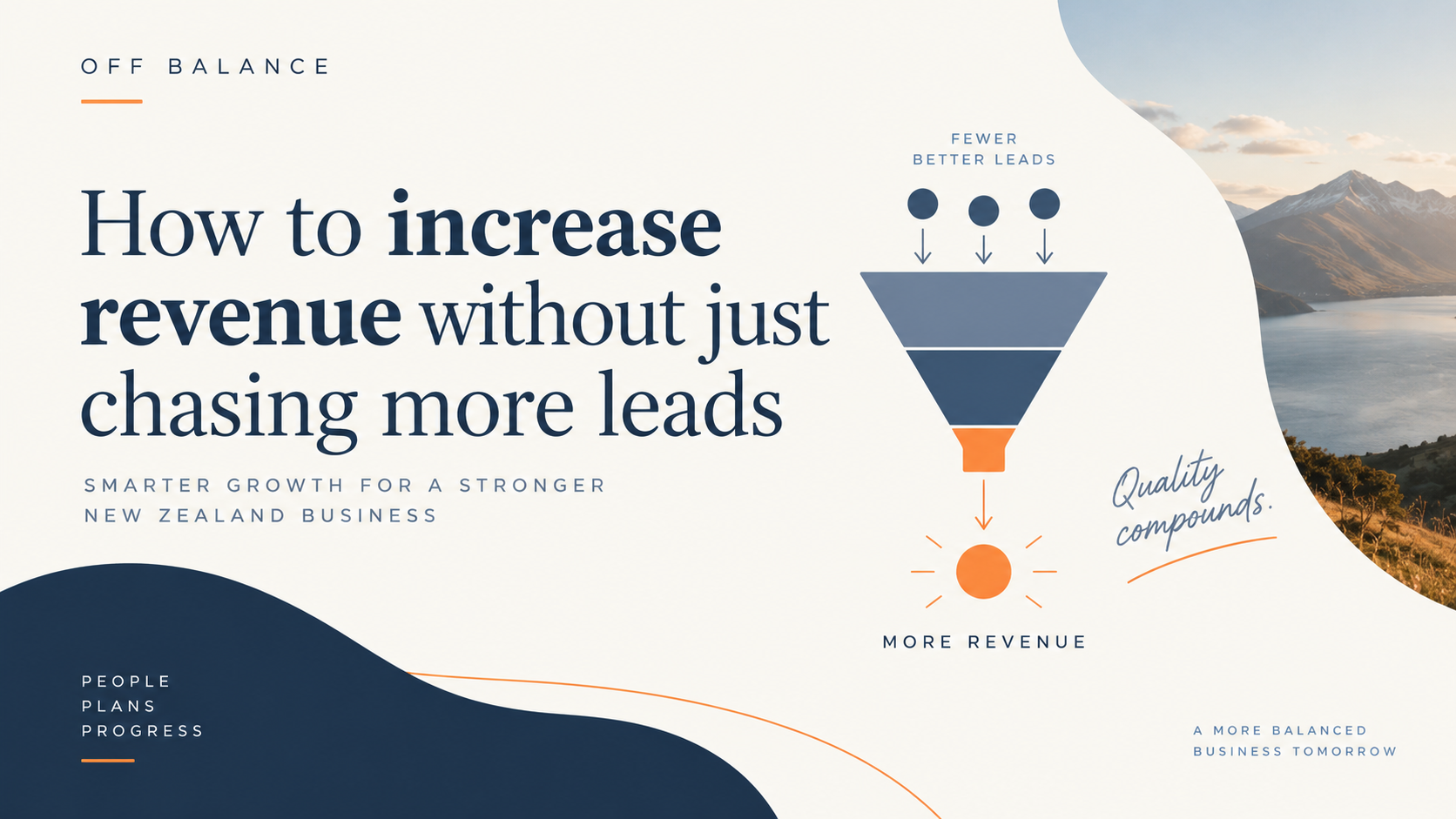
Before you spend more money getting people through the door, check what happens once they arrive.
To increase small business revenue, identify the part of your sales process that is holding you back. It might be too few suitable enquiries. It might be low conversion, an unclear offer, pricing or customers who never return. More marketing is only one possible answer.
“Grow sales” is a goal. It is not yet a plan.
The invoice that made Off Balance feel real
When Off Balance’s invoice #0001 was paid, I shared the milestone.
A small milestone and a very good feeling.
After years in accounting, Xero and commercial roles, I was back at the beginning with my own business. Someone had moved beyond liking an idea and had actually paid for the work.
That is the distinction I want to keep in front of me as I build. An encouraging conversation matters. A signed piece of work matters differently. Money arriving matters differently again.
You need to know which of those your growth activity is producing.

Find the missing step, not just the missing revenue
Take your most recent ten enquiries. Where did each come from? Was it a genuine fit? Did you have a proper conversation? Was a proposal sent? Did they buy? If not, do you know why?
This is not about building a complicated dashboard. You can start with ten rows.
If there are barely any suitable enquiries, look at the audience, message and channel. If good prospects keep disappearing after the proposal, adding more prospects may just create a bigger follow-up problem.
If customers buy once but do not return, examine the experience and whether there is a genuine reason to buy again. Not every business should force a subscription onto something that is naturally a one-off purchase.
A simple revenue example
Imagine a service business receives 40 qualified opportunities in a month. It wins 25% of them, at an average initial sale of $2,500 excluding GST.
That is 10 customers and $25,000 of initial sales.
At the same opportunity volume and sale value, a 35% win rate would mean 14 customers and $35,000 of initial sales.
That is a 40% increase in this example, without increasing the number of opportunities. It is arithmetic, not a promised result. It assumes the business can win and deliver the extra work without changing price or costs per job.
It also leaves an important question: can the team deliver those four additional jobs well, at a worthwhile margin, and get paid on time?
More sales are not automatically better sales.

Choose one revenue lever
I would look at four places before writing a bigger marketing budget.
Fit. Are you attracting people with the problem you solve, the ability to pay and a reason to act? A smaller number of good-fit conversations may be more useful than a full inbox of unsuitable enquiries.
Conversion. Does the customer understand what they get, what happens next and what the decision involves? Look at proposal clarity and follow-up before deciding price is the only issue.
Value. Is there a better-scoped option that genuinely solves more of the customer’s problem? This is not about selling extras they do not need. It is about making a useful offer clear.
Repeat business. When would the customer naturally need help again? Build a relevant check-in around that moment rather than an endless stream of “just touching base” emails.
Pick the weakest meaningful link. Trying to change all four at once makes it harder to see what actually helped.
Do you need more people interested in your business, or a better reason for the right people to buy?
Run a 30-day test
Suppose your review shows good-fit proposals regularly stall. Your experiment could be agreeing a decision date during the sales conversation, simplifying the proposal and following up on that date.
Write down the current baseline. Choose one person to own the test. Measure qualified proposals, wins, average sale value and gross profit on the work won. Record the reasons people decline.
Thirty days is a review window, not a promise that every sales cycle will finish inside it. Compare similar opportunities and allow for small sample sizes. One unusually large deal can make a weak process look brilliant.
Keep what works. Adjust what does not. Then tackle the next constraint.

Two common growth questions
Should I lower my prices to win more customers?
Only after checking the effect on margin and the reason people are saying no. If the offer is confusing or the customer is not a fit, a discount can reduce what you earn without solving the real problem.
What should I measure first?
Start with suitable enquiries, conversion to paying customers, average sale value and the margin on work won. Add cash collection timing so booked revenue does not get mistaken for money available to spend.
Turn the target into something you can act on
Before your next growth meeting, finish this sentence: “Revenue is being held back mainly by ______, and our next test is ______.”
That is a better starting point than “we need to do more marketing”.
At Off Balance, Growth Advisor connects your revenue goals with the commercial drivers, financial plan and three clear priorities for the next quarter.
Tell me where sales are getting stuck. We’ll work out which part of the process deserves attention first.
